
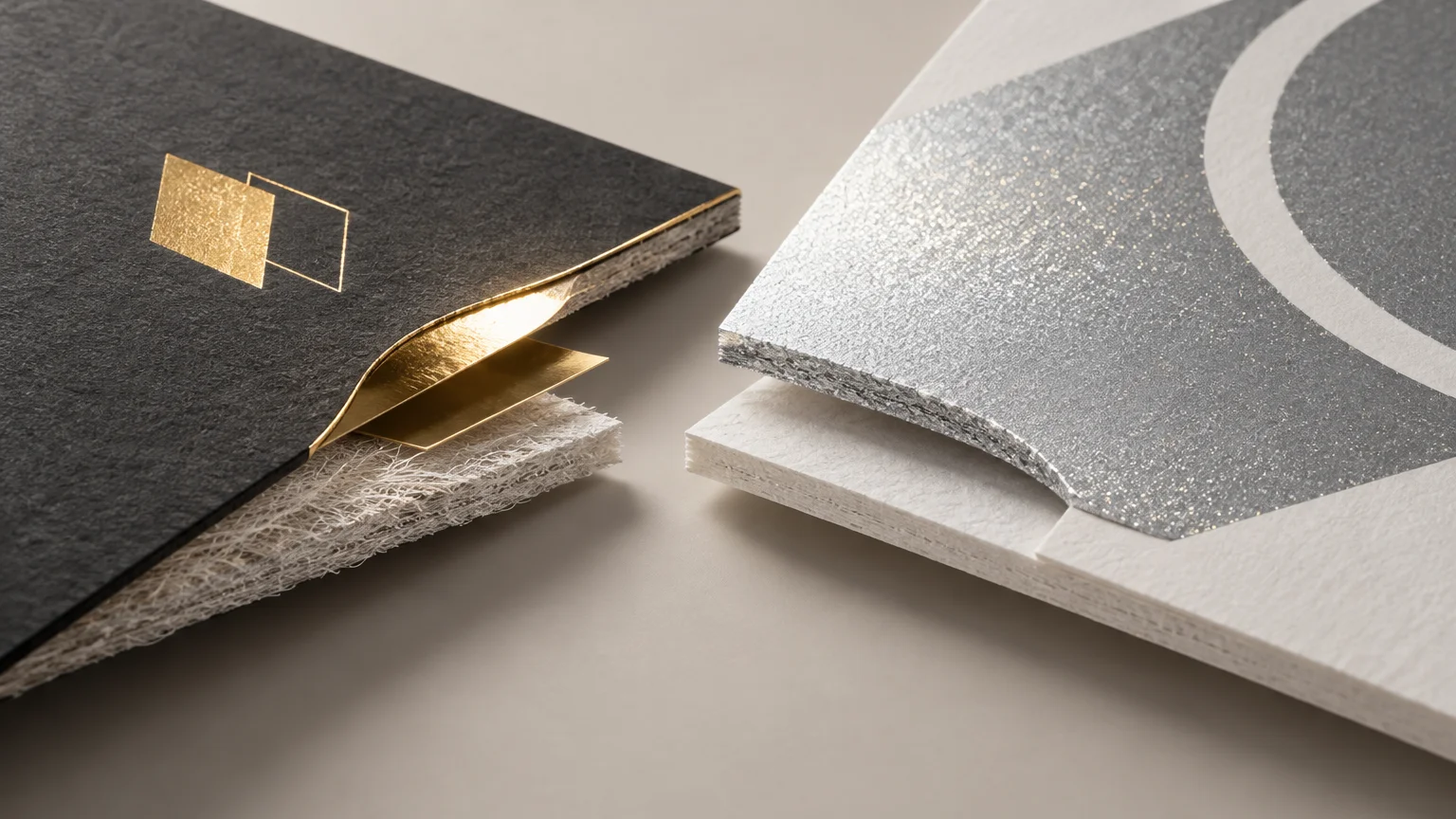
Foil vs Metallic Ink: Production Differences Beyond the Shine
TLDR
In a foil vs metallic ink decision, choose by construction rather than by the color name. Conventional hot foil stamping transfers a thin decorative layer onto the substrate using a die, heat and pressure. Metallic ink deposits an ink film containing reflective pigment. Foil is usually the stronger starting point for a sharply defined, mirror-like accent; metallic ink fits an ink-printing workflow and can be more suitable for printed metallic areas or imagery. In either case, approve a physical sample on the intended stock with the actual coating, laminate, folds and converting steps.
The important question is not whether both options can be called gold or silver. It is what physical layer will remain on the finished piece, how that layer reaches the surface and what happens to it afterward. Those mechanics determine brilliance, edge behavior, registration demands, stock sensitivity and the artwork your printer needs.
Foil vs metallic ink at a glance
| Decision factor | Conventional hot foil | Metallic ink |
|---|---|---|
| What creates the effect | A decorative layer transferred from a multilayer foil construction | Reflective pigment suspended in a printed ink vehicle |
| Production operation | A die or engraving applies heat and pressure | Ink is deposited by the selected printing process |
| Appearance to evaluate | Reflectivity, coverage, edge definition and interaction with surface texture | Pigment orientation, hiding power, ink-film uniformity and substrate influence |
| Artwork requirement | Dedicated foil mask or named spot separation | Dedicated named spot-color separation |
| Stock sensitivity | Surface texture and construction can affect transfer and edge quality | Absorbency, roughness and unevenness can affect pigment orientation and brilliance |
| Finishing concern | Registration, folds, scores, seams, abrasion and subsequent converting | Drying, rub resistance and the brilliance loss that coatings or laminates may cause |
| Approval method | Physical production sample using the proposed foil, stock and die conditions | Physical drawdown, press proof or production sample on the intended stock |
This comparison uses conventional hot foil as the foil process. The metallic-decoration category also includes cold foil and digital transfer methods, so a quote that merely says “foil” is incomplete. PRINTING United’s overview of the changing metallic-decoration landscape is a useful introduction to why the process must be named rather than inferred. Read its overview of metallic decorating methods.
What physically happens during hot foil stamping
A hot-stamping unit brings a heated die or engraving into contact with foil and the printed substrate under pressure. The relevant decorative layers release from the foil carrier and bond to the receiving surface in the image defined by the die. That combination of a shaped tool, temperature, pressure and contact time is what makes hot foil a transfer operation rather than another ink color.
The roll called foil is itself a multilayer production material. KURZ identifies a polyester carrier, a release layer, protective and chromophore layers, vacuum-metallized aluminum and a heat-sealing adhesive in its hot-stamping foil construction. The polyester carrier supports the transfer system; it is not intended to become the visible film left on the finished piece.
This construction helps explain the characteristic reflectivity of many metallic foils. The effect comes from a transferred metallized layer with protective and color-forming components, not from separate pigment particles distributed through a wet ink film. A smooth receiving surface can preserve a cleaner reflection, while a textured or irregular surface may disrupt contact and alter the result.
The die also introduces constraints upstream. Fine reverses, small counters, closely spaced elements and large solids do not necessarily transfer under identical conditions. The acceptable geometry depends on the foil, die, substrate, press and operator settings. Ask the producer for its minimum line, gap and type requirements rather than copying a generic specification from another job.
What physically happens with metallic ink
Metallic ink carries reflective effect pigment in an ink vehicle. Once printed, the pigment particles must distribute and orient within the deposited film. The surface below that film influences how evenly this happens and how much light returns to the viewer.
A useful example is ECKART’s METALSTAR SuperEco 08 4006 Silver, a specific conventional offset ink based on leafing aluminum pigment. Its technical sheet lists a median pigment size of approximately 6 micrometres and pigment content of approximately 16 percent. Those figures describe that product, not metallic inks as a universal class, but they illustrate why metallic ink must be treated as a particle-bearing ink system rather than an ordinary gray with a metallic color name.
The same documentation warns that absorbent or uneven substrates can affect pigment orientation, brilliance, hiding power, transfer and adhesion. It notes that a primer may improve the surface in some applications. A smooth coated sheet and an absorbent uncoated board can therefore produce visibly different metallic effects from nominally similar ink.
Metallic ink can be a logical choice when the design belongs in the ink-printing stage and the target effect does not require the distinct transferred surface of foil. It may also suit designs involving screened or image-like metallic content, but tint behavior, trapping and color sequence must be tested with the actual ink system. Do not assume that a conventional color proof can predict how reflective pigment will orient on press.
The finishing stack can change the answer
Evaluate the complete object as a stack: substrate, primer or underlying print, metallic layer, protective finish and converting operations. A successful metallic effect before finishing can become less reflective after varnishing or lamination, or it can be damaged where the piece rubs, folds or contacts production hardware.
For the cited ECKART offset ink, overprint varnish can improve rub resistance while reducing metallic brilliance. Its documentation also states that lacquer and laminate finishes reduce brilliance and calls for individual testing because many variables influence the result. That creates a real engineering tradeoff: the finish added to protect a metallic ink film may also suppress the quality that made it desirable.
Hot foil has a different layer construction, but it still needs finished-object testing. A metallic element crossing a score, fold, carton seam or die-cut edge may face bending, stretching, pressure or abrasion after decoration. On folding cartons, board thickness also changes fold geometry; the principles in this guide to folding-carton panel compensation help explain why the flat artwork alone cannot predict the erected result.
Set up artwork as a production instruction
A metallic separation is not merely a visual simulation. It tells prepress where a die must transfer foil or where a press must deposit a dedicated ink. Keep that instruction unambiguous even if the layout also contains a gold-looking CMYK preview.
- Name the exact process in the specification: conventional hot foil, metallic spot ink, cold foil or the provider’s identified digital transfer process.
- Create a dedicated vector spot separation with a clear name such as HOT_FOIL_GOLD or METALLIC_SILVER. Do not encode the instruction only through an RGB or CMYK appearance.
- Ask whether the metallic object should overprint or knock out underlying colors. The correct answer depends on the process, opacity, trapping plan and desired appearance.
- Show folds, scores, seams, glue areas, die cuts and high-abrasion zones on nonprinting production layers. Keep them distinct from the metallic mask.
- Document the complete stack, including primer, white ink, process color, metallic operation, varnish or laminate and converting sequence.
- Obtain provider-specific limits for minimum lines, gaps, type, reverses, registration and screened areas. Do not assume one supplier’s limits apply to another.
- Approve a physical sample made with the intended substrate and protective finish. A monitor rendering can communicate placement, but not reflectivity or surface interaction.
If the file uses transparency to preview the metallic area, remember that transparent artwork, a white object, white ink and bare substrate are different production conditions. This prepress guide to transparent and white backgrounds explains that distinction. Likewise, an RGB-to-CMYK conversion controls ordinary process color; it cannot reproduce the directional reflection of foil or metallic pigment. See how RGB and CMYK conversions behave in print workflows for the surrounding color-management issues.
Do not treat every foil method as hot foil
Cold foil and digital foil or sleeking-style processes can produce metallic decoration, but they do not share one universal transfer mechanism. Cold foil generally belongs to an adhesive-and-transfer workflow rather than a heated die operation. Digital systems may create the receptive image without a conventional metal stamping die. Equipment, foil compatibility, substrate requirements and overprinting options vary by system.
That variation changes both artwork and purchasing. Before requesting “gold foil,” ask the provider to identify the process, the receiving layer and the order of operations. If a metallic concept is being adapted into a label or sticker, verify that the chosen process is offered before moving from file preparation to custom sticker ordering. The navigation destination does not substitute for a process confirmation or production proof.
Three practical selection examples
A small mirror-like mark on a premium cover
Evaluate hot foil first. Its transferred metallized layer is better aligned with the request for a distinct reflective accent. Ask for the available foil swatches on the final cover material, then test the smallest details and any combination of foil with embossing or debossing. Registration between separate finishing operations requires explicit discussion.
A broad silver area on a commercial printed sheet
Evaluate metallic ink alongside the intended paper and coating. A drawdown or press proof should answer whether the stock holds the ink near the surface, whether the pigment appears even and whether the protective finish removes too much brilliance. Do not select the ink from a digital mockup alone.
Colored metallic imagery or gradients
Do not choose from the words foil or ink alone. Ask how the provider constructs colored metallic imagery: a metallic base overprinted with color, a colored foil, a metallic ink formulation or another system. Each route creates different trapping, registration and finishing conditions. Request a method-specific sample containing gradients, small type and representative solids.
Questions to resolve before release
- What exact metallic process will be used?
- What material remains on the finished surface?
- Which stock, primer and underlying colors are included in the approved construction?
- Will the metallic separation overprint or knock out?
- What are the provider’s limits for lines, gaps, type and reverses?
- Will varnish, lacquer or laminate reduce brilliance?
- Does the metallic area cross a fold, score, seam, cut or glue zone?
- What rubbing or handling must the finished piece withstand?
- Can the producer supply a physical proof or a closely matched production sample?
- Will the proof include the final substrate and finishing stack?
The production recommendation
Start the foil vs metallic ink decision with a physical target. If the design calls for a sharply defined, mirror-like accent or a foil-and-emboss construction, evaluate conventional hot foil first. If the metallic effect belongs within an ink-printing workflow, evaluate a metallic spot ink on the actual substrate. For colored imagery or unfamiliar decoration systems, let the provider’s named process determine the file setup.
Before releasing artwork, obtain three things in writing: the exact metallic method, the required spot-separation rules and the full finishing sequence. Then approve a physical proof or production sample made on the final stock. Metallic decoration is unusually dependent on surface and viewing conditions, so the most useful proof is not the one that looks convincing on screen; it is the one built like the finished object.