Paper Grain Direction and Why It Matters for Folding
For most brochures, cards, covers and booklets, run the paper grain parallel to the principal fold or spine. That orientation usually reduces resistance at the hinge, produces a cleaner fold and lowers the risk of visible cracking. It is the practical default for paper grain direction folding printing decisions, but it is not a complete cure: stock condition, printed coverage, coatings, laminates, score geometry and folding sequence all affect the result.
The most useful specification is therefore not simply “grain long” or “grain short.” State how the grain must relate to the finished object: “grain parallel to the 210 mm spine,” for example. That remains clear even if the printer changes the parent sheet, imposition or press format.
What paper grain direction means
During papermaking, fibers tend to become more strongly oriented in the direction the web travels through the machine. This creates two principal directions with different mechanical behavior: the machine direction, commonly called the grain direction, and the cross direction.
Grain-long and grain-short describe how that direction relates to a cut sheet. On a grain-long sheet, the grain follows the longer dimension. On a grain-short sheet, it follows the shorter dimension. These labels describe the sheet as supplied, not the finished product. Once several pages or panels are imposed on a larger press sheet, the relationship can become ambiguous unless the fold or spine is named explicitly.
A printer may also rotate artwork on the press sheet to improve yield. That rotation can change the finished grain orientation without changing the page dimensions. If fold behavior matters, grain must be treated as an imposition requirement rather than a detail to check after printing.
Why folding parallel to the grain is usually safer
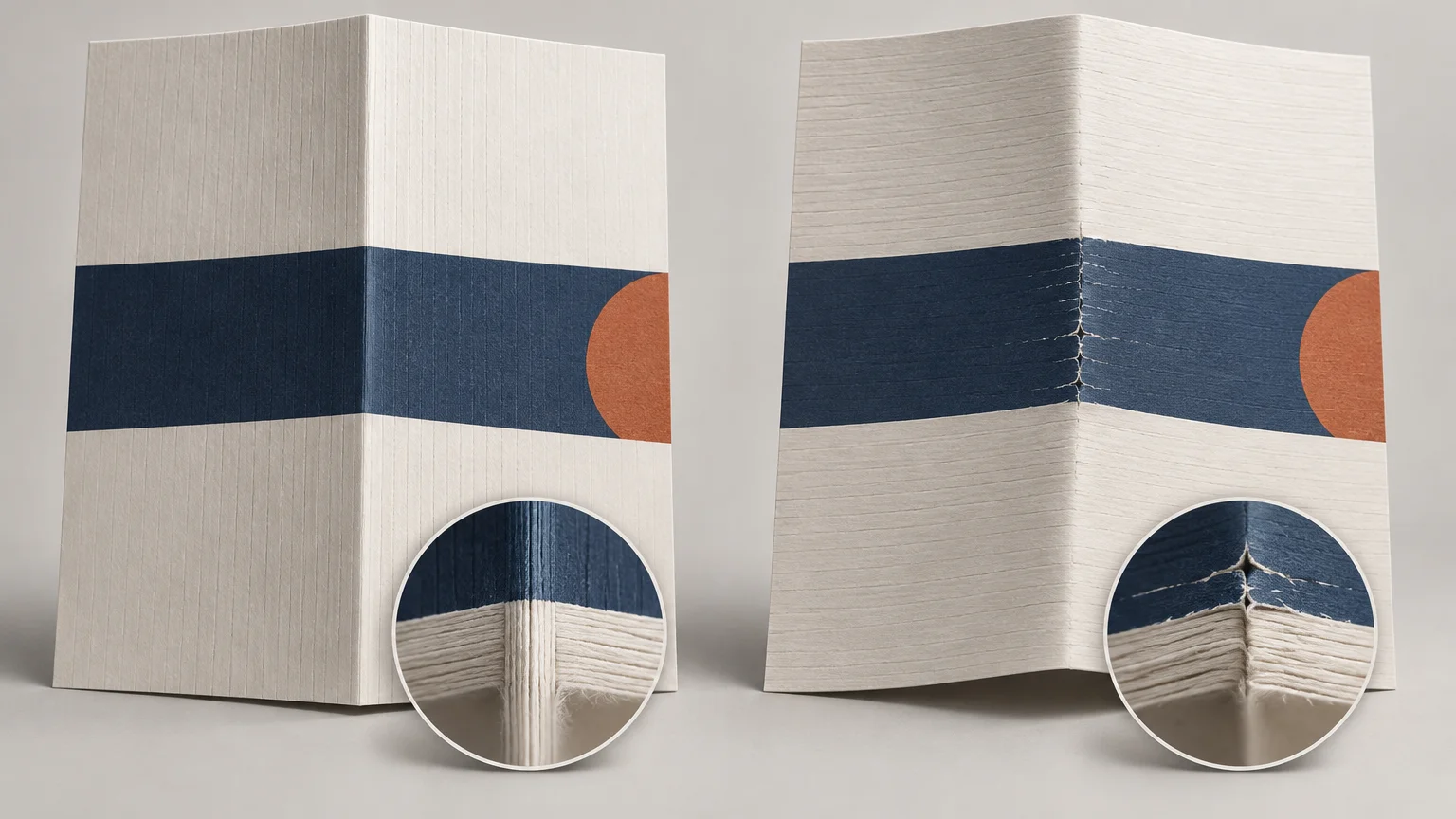
A fold parallel to the grain asks the sheet to bend mainly along the dominant fiber orientation. Folding across it forces more fibers to accommodate the bend across their preferred alignment. In practical terms, the across-grain fold often feels stiffer, springs back more strongly and places greater strain on the outside surface.
That outside surface must travel farther around the fold than the inside surface. Paper fibers, coating, ink, toner, varnish or laminate must all tolerate that extension. If one layer cannot, the failure appears as a rough hinge, fractured coating, white line through dark artwork, split laminate or a cover that resists staying closed.
Sappi’s technical guidance recommends that the final fold run parallel to the paper grain. It also identifies printing across a fold, low residual moisture or unsuitable climatic conditions, and brittle ink or varnish systems as contributors to cracking or reduced flexibility. In particular, UV inks and UV varnishes can increase brittleness, so correct grain alone cannot guarantee a clean result. Sappi’s folding and scoring guidance explains these interacting factors in more detail.
Paper grain direction for common folded products
| Printed piece | Preferred grain relationship | Production concern |
|---|---|---|
| Bi-fold card or brochure | Parallel to the main fold | Reduces hinge stiffness and the risk of a visibly fractured fold. |
| Saddle-stitched booklet | Parallel to the spine | Supports cleaner signature folds and easier opening. |
| Perfect-bound cover | Parallel to the spine and cover hinges | Helps the cover flex at its scores instead of resisting the opening motion. |
| Presentation folder | Parallel to the dominant body fold when practical | Pocket folds and glued tabs may create additional constraints that need a dummy. |
| Accordion or gate fold | Parallel to the most important repeated folds when possible | A layout with folds in two directions requires prioritization and testing. |
| Folding carton | Set with the converter for the actual structure | Panel geometry, crease rules, board properties, gluing and machine direction must be evaluated together. |
Booklets make the functional effect especially easy to notice. Pages folded across the grain may resist opening and push the booklet toward closing again. Covers can show the same spring-back around a spine or hinge. Grain parallel to the spine is therefore the usual lower-risk orientation for opening and repeated handling.
Cartons require more caution. Grain influences bending and panel stiffness, but package construction introduces load direction, crease geometry, panel compensation and converting-machine requirements. Do not transfer the brochure rule blindly to every carton. Confirm the direction on the converter’s dieline and evaluate it with the erected structure. The relationship between board thickness and panel geometry is explored further in this guide to folding-carton panel compensation.
Scoring helps a fold, but it does not erase grain
Folding bends a sheet. Scoring or creasing first creates a controlled line intended to become the hinge. The terminology and tooling vary by process, but the production objective is similar: localize the deformation so the material folds where intended rather than buckling or breaking unpredictably.
A score can make a heavier or coated sheet substantially easier to fold, yet it cannot restore flexibility to a brittle printed layer or make an unsuitable grain orientation irrelevant. An excessively narrow, shallow or misplaced score may fail to form an adequate hinge. An aggressive score can distort the surface, weaken the sheet or interfere with artwork. The useful score depends on the stock’s caliper and construction as well as the folding equipment.
There is no responsible universal GSM value above which every sheet must be scored. Two stocks with the same basis weight can differ in caliper, fiber composition, coating, moisture condition and stiffness. Dense toner or ink coverage across the hinge can further change the result. Treat weight as an initial signal, not a complete scoring specification.
Why a printed fold cracks
A white or ragged line at a fold is a symptom, not a single diagnosis. Examine which layer has failed before changing the file or finishing setup.
- Exposed or fuzzy fibers suggest the paper structure or coated surface has fractured. Check grain orientation, stock condition, fold radius and score suitability.
- A white line visible only through a dark printed area may indicate that the colorant or coating cannot stretch with the substrate. Review coverage at the hinge and test the actual print process.
- A flaking or segmented surface can point to a brittle ink, toner or varnish layer rather than the base sheet alone.
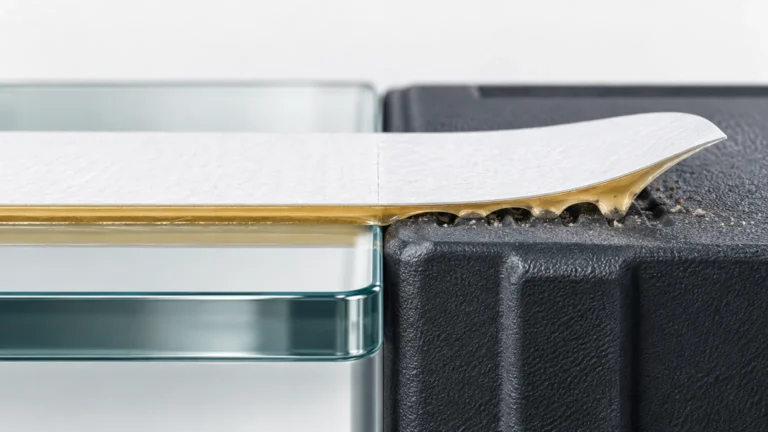
- A lifted, tunneled or split film indicates that the laminate and its bond must be considered as part of the fold construction.
- A fold that wanders beside the score may indicate score placement, folding registration, panel geometry or equipment setup rather than grain direction.
- A clean-looking fold that springs open strongly may still have excessive across-grain stiffness or an unsuitable score geometry.
Removing a dark background from the fold can make cracking less conspicuous, but that is visual risk management rather than a mechanical repair. The underlying sheet may still be fracturing. Conversely, artwork that looks acceptable on an unprinted dummy may fail after toner, UV varnish or laminate is added. Sappi specifically notes that printing can reduce flexibility.
How to identify grain before production
Supplier labeling is the best starting point because small hand tests can be subjective. If the direction is undocumented, compare more than one indicator on an unprinted sample.
- Bend the sheet gently in both directions without making a permanent fold. The direction that offers less resistance commonly corresponds to a fold parallel with the grain.
- Moisten a small waste sample and observe its curl. Unequal expansion across the two directions can reveal the grain relationship, although this is a destructive test and should not be performed on production sheets.
- Tear waste strips in both directions. One tear may track more cleanly while the other wanders, but coatings and sheet construction can obscure the result.
- Confirm the finding with the paper merchant or printer before imposing a critical job. Record the required direction on the production specification and dieline.
These checks are useful for prototypes and unidentified stock, but they are not substitutes for production documentation. A cut-sheet label can also be lost after trimming, so mark the grain direction on retained samples and dummies.
When a design has folds in two directions
Some structures cannot place every fold parallel to the grain. Cross-fold brochures, presentation folders, envelopes and cartons may contain important hinges at right angles. The engineering task then becomes prioritization.
Give the preferred grain orientation to the fold that carries the greatest functional demand: a booklet spine, repeatedly opened cover hinge, long structural fold or highly visible fold through dark coverage. Use an appropriate score on the secondary folds and test the complete sequence. Folding order matters because one fold can constrain the material presented to the next station.
A blank paper dummy can confirm panel order and approximate stiffness, but it cannot reproduce the behavior of a printed, coated or laminated surface. For critical work, approve a representative sample made with the intended stock, print coverage, finishing layers, score and fold sequence. When a folded invitation advances from layout to ordering, a specification-led route for printing folded invitations should carry those requirements with the artwork rather than leaving grain and scoring implicit.
Grain, feeding and registration
Grain direction can affect sheet stiffness and curl, so it may be one factor in feeding and transport. It should not, however, be treated as a universal cure for misfeeds or registration movement. Humidity, static, pile conditioning, sheet curl, trim quality, feeder settings and machine configuration can produce similar symptoms.
If changing sheet orientation improves feeding, record what changed and verify that the new orientation does not compromise the finished fold. A mechanically convenient press direction can create a poor product direction. The production decision has to satisfy both stages.
What folding-endurance tests can and cannot tell you
Laboratory folding-endurance tests repeatedly flex a paper specimen under controlled conditions until failure. TAPPI T 511 expresses the result as the logarithm of the number of double folds and calls for specimens to be tested in both principal paper directions. The method also controls variables including fold radius, tension, equipment calibration and relative humidity.
ISO 5626 likewise defines standardized methods for determining paper folding endurance and distinguishes methods by applicable thickness ranges. The ISO 5626 standard listing provides the formal scope.
These methods are valuable for comparing paper behavior under defined laboratory conditions. They do not directly predict whether a finished brochure will crack after printing, scoring, varnishing or laminating. A production fold combines a different geometry with additional material layers and process variables. Use laboratory data to understand the substrate, then use a representative folded proof to evaluate the actual object.
A practical specification checklist
- Mark every fold, score, perforation and spine on the dieline.
- Identify the principal functional fold rather than asking vaguely for long-grain paper.
- Write the grain relationship and finished dimension together, such as “grain parallel to the 210 mm spine.”
- Flag dark solids, heavy ink or toner coverage, UV varnish and laminate that cross a fold.
- Ask the printer or converter to select score geometry for the actual stock and finishing stack.
- Confirm whether imposition or sheet-yield changes would rotate the finished piece relative to the grain.
- For multi-directional folds, agree which hinge receives priority.
- Approve a printed, finished and folded sample for high-risk work rather than relying only on a blank dummy.
- Retain the approved sample and record the stock, grain direction, print process and finishing setup for repeat production.
If the job uses an unfamiliar heavy sheet, start by understanding its construction rather than making assumptions from weight alone. The distinction between weight, thickness and stiffness is also important when choosing cardstock for printed pieces.
Specify the finished relationship, then test the stack
The low-risk default is simple: place the paper grain parallel to the principal fold or spine whenever the structure permits. The production specification should name that relationship explicitly so it survives changes to sheet size and imposition.
Then validate the whole construction. Fold quality is created by the interaction of paper, moisture condition, ink or toner, coating or laminate, score geometry and folding sequence. For the next critical job, mark the principal fold on the dieline, state the required grain relationship and request one representative printed, scored and folded sample before approving the full run.